


Many investors own portfolios with significant embedded unrealized capital gains. On the one hand, such large gains imply the successful implementation of a positive investment strategy over time. On the other hand, these gains make it painful and highly costly for the investor to pivot and make rapid investment decisions in changing investment climates. This Navigator delineates a host of strategies to address portfolios with material unrealized taxable gains to provide increased flexibility in the years ahead.
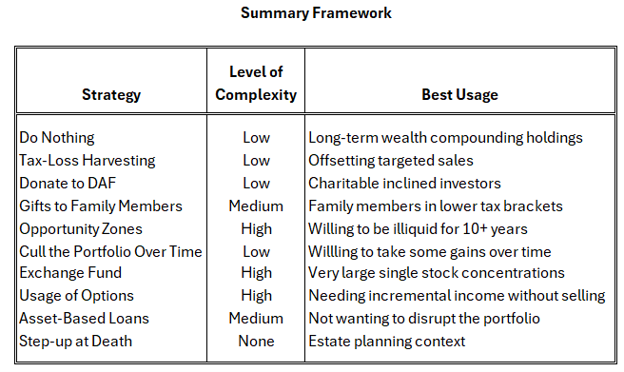
Do Nothing
The simplest investment strategy can often be the right one. Unrealized capital gains are not taxed until the investor makes the decision to sell. If these are high-quality wealth compounding assets that investors may want to hold for decades, sometimes the best tax strategy is simply not triggering the gain. Warren Buffett has held Coca-Cola stock inside of Berkshire Hathaway since 1988 partly for this reason — the embedded tax liability becomes a form of interest-free loan from the government as long as the security is not liquidated.
However, the global economy is constantly changing, impacted by inexorable technological advancements, economic growth, productivity improvements, demographic transformations, geopolitical events, regulatory changes, and other factors. Today’s amazing wealth compounder may well become tomorrow’s Sears Roebuck. A listing of the 20 components of the Dow Jones Industrial Average from 1926 is provided in the appendix of this Navigator; Sears Roebuck can be found in the Dow Jones that year. The year 1926 was chosen because it was exactly 100 years ago. None of the 1926 Dow Jones constituents remain in the index today. Eight constituents were absorbed by other companies, five were dissolved or went bankrupt, and only seven companies still survive today. Thus, while doing nothing can often make sense, over longer periods of time flexibility becomes increasingly important for investors.
Harvest Losses Elsewhere to Offset Gains
Should there be any positions in the portfolio sitting at a loss, exiting these investments generates capital losses that directly offset capital gains dollar-for-dollar. This strategy is called tax-loss harvesting. The investor can then immediately reinvest the proceeds in a similar (but not identical) security to maintain market exposure. It is important to pay close attention to the 30-day wash sale rule, which disallows the loss if the investor buys the same or substantially identical security within 30 days before or after the sale.
Charitable Giving
If an investor has charitable inclinations, donating appreciated stock directly to a charity or Donor-Advised Fund (DAF) is one of the most tax-efficient strategies available:
- The investor avoids paying capital gains tax entirely on the appreciated shares.
- The investor gets a charitable deduction for the full fair market value.
- The charity or DAF sells the shares tax-free and deploys the full proceeds.
A DAF is particularly useful because the investor can front-load a large charitable contribution in a high-gain year, get the deduction immediately, and then distribute the money to actual charities over many years at a leisurely pace.1
Gifting to Family Members in Lower Tax Brackets
Appreciated stock can be gifted to family members in the 0% long-term capital gains bracket (in 2026, single filers under ~$48,000 in taxable income). They can then sell the shares and pay zero Federal capital gains tax. The limit for the annual gift tax exemption without taking anything from lifetime exemptions is $19,000 per person (subject to applicable requirements).
Opportunity Zone Investments
If appreciated stock is sold and the gains are subsequently reinvested into a Qualified Opportunity Zone Fund (QOZ) within 180 days, significant tax savings are possible.2 If the investor holds the QOZ investment for 10+ years, any new appreciation in the Opportunity Zone investment itself is completely tax-free. This strategy is complex and illiquid, but, for very large gains, it can be meaningful and worth the aggravation.
Cull the Portfolio Over Time
Trimming securities with significant unrealized capital gains over time can be sensible. While a certain amount of taxes will undoubtedly be paid, keeping the capital gains at a reasonable level is prudent. Doing a certain amount of portfolio trimming over time can help with portfolio balance and may improve risk-adjusted returns in the years ahead, while limiting the tax impact in any one tax year.
Exchange Funds
An exchange fund is a private partnership structure where multiple investors with concentrated positions pool their stock. Investors contribute appreciated shares and receive a diversified interest in the fund — deferring the capital gain indefinitely. After 7 years, the investor can redeem the fund for a diversified basket of stocks. This strategy is only available to accredited investors, typically requires a minimum contribution of $1-5 million, and involves significant illiquidity and complexity.
Option Hedging Strategies
If you want to reduce downside risk on a concentrated position without triggering a sale, a series of option overlay strategies may be helpful.
- Protective put options — buy puts to protect the downside while maintaining upside and deferring the gain
- Collar — buy a put and sell a call simultaneously, capping upside but protecting downside at low or zero net cost
- Covered call options — sell calls to generate incremental income and limit downside risk; the catch here is that the investor caps investment upside at the strike price of the call.
These are sophisticated option overlay strategies that typically require a competent investment advisor to execute properly.
Asset Based Loans
Our primary custodians, Pershing Advisor Solutions and Charles Schwab, both offer loans to clients that custody their assets with these companies. With substantial investment assets, regardless of the underlying capital gain, investors can establish a credit line based on these investments. Therefore, rather than selling investments to raise capital (which could trigger capital gains and undermine the portfolio growth potential), the investor can gain ready access to cash without disrupting the portfolio or tax plans.
The benefits for these asset-based loans include enhanced liquidity, wide flexibility to use the cash, investment continuity, tax-efficiency, and competitive but variable interest rates. That being said, these loans remain financial obligations and should be handled with care. If the pledged assets fall below the value necessary to support the credit line, the lender will demand that either the loan be paid down, additional assets be pledged as collateral, and/or assets in the portfolio be identified for sale.
Step-Up in Basis at Death
If the investor holds appreciated stock until death, his/her heirs typically receive the shares with a stepped-up cost basis equal to fair market value on the date of death, eliminating the embedded capital gains entirely. For older investors with large gains and estate planning objectives, this is a legitimate and commonly used strategy. Conversely, for investors with large estates, they cannot entirely avoid taxes, as Federal and state taxes (only in some states) will limit the size of the estate inherited by the heirs.
Conclusion
The right combination of the aforementioned strategies depends on your age, income level, willingness to bear concentrated risk, understanding of complex investment strategies, and estate planning goals. Your Pekin Hardy Strauss portfolio manager can model the potential outcomes of each scenario with your specific situation. Should you wish to discuss any or all of these investment strategies, please reach out to your portfolio manager to learn more.
This article is prepared by Pekin Hardy Strauss, Inc. (“Pekin Hardy”, dba Pekin Hardy Strauss Wealth Management) for informational purposes only and is not intended as an offer or solicitation for business. The information and data in this article does not constitute legal, tax, accounting, investment or other professional advice. The views expressed are those of the author(s) as of the date of publication of this report and are subject to change at any time due to changes in market or economic conditions. Pekin Hardy cannot assure that the strategies discussed herein will outperform any other investment strategy in the future, there are no assurances that any predicted results will actually occur. The strategies discussed may not be appropriate for all individuals and may vary depending on an individual’s tax bracket, financial circumstances, and other factors.
1 More detail on donor-advised funds can be found at https://pekinhardy.com/unlocking-the-tax-benefits-of-charitable-donations/
2 A QOC is an economically distressed community specifically designated by the U.S. Treasury.
Appendix
Companies in the Dow Jones Industrial Average in 1926
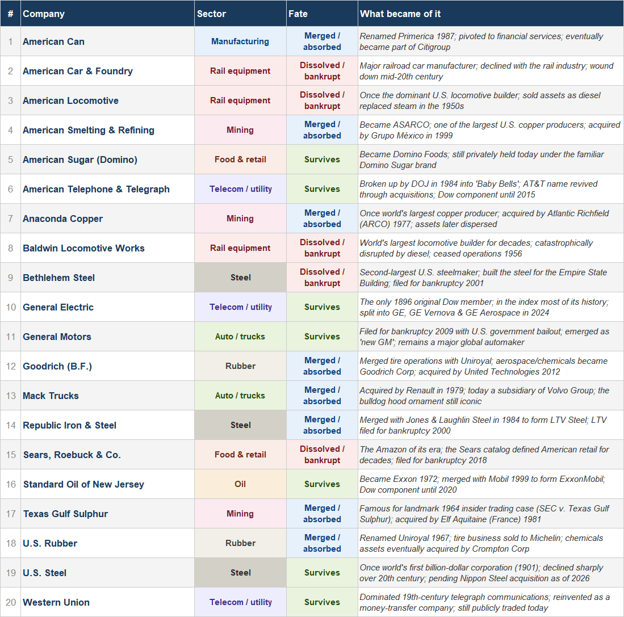
Source: S&P Dow Jones Indices historical records; Wikipedia historical DJIA components; Library of Congress Business History research guides