

“Toto, I’ve got a feeling
we’re not in Kansas anymore.
─ Dorothy, The Wizard of Oz
The investment landscape does feel somewhat surreal these days, like a capital markets version of the Emerald City of Oz. The Strait of Hormuz has been closed for five months, yet oil prices are lower now than in late February, when the Strait was still open. This phenomenon is truly remarkable in light of global oil inventories having plunged by over 1 billion barrels since the start of the Iran conflict to their lowest level since 1990 in what the IEA is calling the largest supply disruption in history. Meanwhile, the U.S. stock market remains overvalued by nearly any valuation metric, even as bond yields continue to rise amid rising inflation concerns. The M2 money supply, a measure of total highly liquid money circulating in the economy, surged in May to a record level, posting the largest monthly increase in five years, while the price of gold has surprisingly fallen since the start of the Iran conflict. Newly minted trillionaire Elon Musk’s money-losing SpaceX went public at a valuation of 100x sales (not earnings). Meanwhile, semiconductor stocks are melting up seemingly every day, even as just about all other stocks languish.
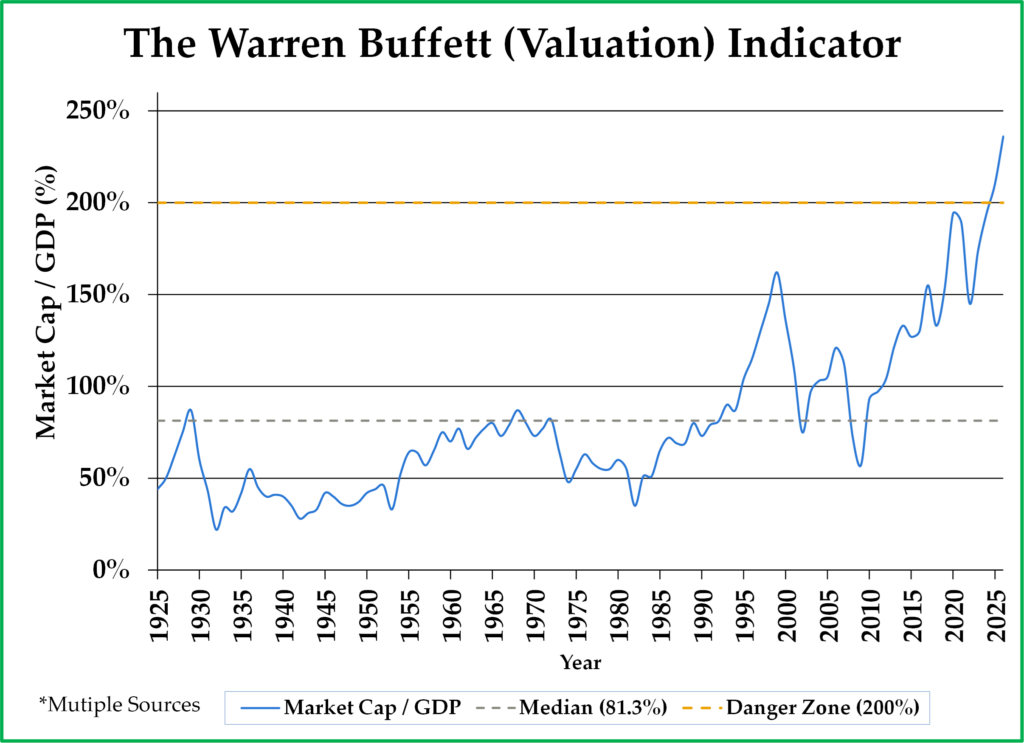
Warren Buffett’s favorite valuation indicator — total U.S. stock market capitalization divided by U.S. GDP — suggests that the market is attractive around the 70-80% area and “playing with fire” rich at 200% of GDP. As of July 6, while we write this letter, the U.S. stock market is valued at 235% of GDP, the highest on record.
While a playing-with-fire valuation might suggest that an investor in an S&P 500 Index fund is likely to generate lower-than-historical-average returns over the intermediate period ahead, it does not portend an imminent stock market crash. The good news is that, for the discerning investor, plenty of overseas and domestic stocks can still be purchased at reasonable prices with compelling expected returns.
To explain some of the strangeness, we would offer several observations about the structure of the market and how it has changed in recent years. First, price-insensitive passive index funds have captured a growing share of investor flows, partly because many retirement plans offer limited investment choices. These flows are driven both by foreign investors seeking a liquid place to park money and generate returns and by domestic investors pushed into passive index funds by their retirement plans. Second, retail investors are increasingly treating the stock market like a casino, with record leveraged bets on short-term price movements through 0DTE (zero days to expiration) options and leveraged ETFs. Third, the money supply continues to grow rapidly, fueling speculation that seems to have no end in sight.
Retail investors are moving quickly from one bubble to the next, riding each one and expecting to get off before the music stops. The rolling bubbles have moved from bitcoin to NFTs to meme stocks to silver and, in 2026, to semiconductor stocks. Last year, the Bubble du Jour was the silver market. From the beginning of April 2025 through late January 2026, the price of silver increased four-fold. The current Bubble du Jour is semiconductor stocks, where, for example, a traditionally boom-and-bust commodity producer of memory chips, Micron Technology, has seen its shares rise in price almost ten-fold since the beginning of August 2025; Micron now has a market capitalization that exceeds $1 trillion. These rolling bubbles tend to come with a narrative that is often at least partially grounded in reality.
How should one invest in such an environment? We believe the economy remains in an inflationary boom, driven by high levels of deficit spending, an expanding money supply, deglobalization, and, more recently, a developing necessity that all countries hold ample inventories of strategic commodity reserves (e.g., rare earth metals, copper, uranium). Outside of the United States and China, most countries will need to build these strategic commodity reserves from scratch, while China and the United States will need to replenish theirs. In this environment, we want our clients to own scarce hard assets and the producers of scarce hard assets, while also being opportunistic in participating in one or more of the rolling bubbles occurring across the capital markets.
Set forth below are a few themes in which we are committing capital to reasonably priced assets with strong and improving fundamentals and satisfactory expected returns, with the possibility that speculative investors might also discover them sooner or later and bid up their prices generating much better than satisfactory returns. These themes include, but are not limited to, nuclear energy, copper, drones, Chinese stocks, and drug development.
- Nuclear Renaissance
We have written a quarterly letter about this topic, and so far, our forecast for long-term uranium demand growth has been, if anything, too modest. We wrote that letter before it was clear how large the A.I. buildout might be and also before the Strait of Hormuz was closed creating an energy security crisis for many nations. The following fundamental trends are highly bullish for uranium prices and uranium mining profitability:
- Energy security is becoming increasingly important. Europe needs a reliable energy source to replace imported Russian natural gas and energy generated by its retiring legacy coal plants. Japan needs to reduce its reliance on oil coming through the Strait of Hormuz. The United States has begun passing pro-nuclear legislation, such as the ADVANCE Act, to triple nuclear capacity by 2050. India also wants to triple its nuclear capacity, and Russia wants to double its capacity.
- Unlike oil, natural gas, and coal, nuclear energy is not a fossil fuel and thus does not create emissions that could contribute to climate change. Unlike solar and wind energy, however, nuclear can provide a steady baseload of electricity that does not depend on the sun shining or the wind blowing at any given time.
- Uranium mining capacity is not growing nearly fast enough to meet expectations of sharply increased future uranium demand. To incentivize new mining to match future demand, the price of uranium and the profits of the uranium mining sector will have to rise substantially.
Currently, the price of uranium is reasonable and should increase markedly in the coming years due to a forecasted supply/demand mismatch. Moreover, a retail buying frenzy moving toward uranium would cause a price adjustment to occur more swiftly.
As an aside, we would suggest that the same logic that applied to uranium also applies to copper, and we are as bullish on copper prices as we are on uranium prices.
- Drone Technology
In 2020, the 44-day war between Armenia and Azerbaijan represented the first drone conflict, and it was clear then that drones were going to change the way wars would be fought henceforth. Ukraine has developed a highly effective drone-based military strategy against Russia. Iran has also been extremely effective at using drones during its recent conflict with the United States.
Iran’s drones have done extensive damage to the military and energy infrastructure of our allies and limited the effectiveness of the U.S. Navy. Iran’s drones are inexpensive, while the United States has spent enormous sums using expensive and difficult-to-build interceptors, which have now been virtually depleted, to combat these plentiful and inexpensive drones. The United States will likely need to approach these conflicts differently in the future, while NATO just pledged to invest $40 billion in counter-UAS (Unmanned Aircraft System) capabilities. The sudden dominance of unmanned drones represents a sea change in military technology rather than an incremental shift, affecting wars and military-budget priorities for decades to come.
While military expenditures are likely to continue to grow inexorably, we expect to see a tsunami of government spending directed toward drone-based military technology and the most innovative companies in this sector. The U.S. Department of Defense has launched an initiative to accelerate the deployment of drones under 55 pounds, loosened acquisition restrictions, and prioritized companies that can offer rapid testing and fielding. The goal is nothing less than drone dominance. Meanwhile, other countries are not standing still on drones, as can be seen in nearly every conflict now taking place around the world.
- Chinese Stocks
The Chinese economy boasts several positive fundamental characteristics. Its currency is undervalued. Declining interest rates should support valuations of Chinese companies with growing earnings. Its manufacturing and supply chain prowess is the best in the world by a considerable margin; China’s industrial products are generally both higher-quality and lower-priced than those of the rest of the world. Besides the United States, China is the only other country with a strong A.I. industry, and it is competing fiercely against the United States to take the top spot. Finally, and importantly, relations between the United States and China seem to be warming up, ever so cautiously.
Nevertheless, Chinese stocks remain quite out of favor, despite the strong fundamentals summarized above. These dynamics have not yet captured the attention of Western investors. We have been asking ourselves a number of important questions, all of which are positive for Western investors:
- What happens if China surpasses the United States in the A.I. race, as some are forecasting?
- What happens if China revalues its currency upward to reduce its trade imbalances and improve the quality of life for its citizens?
- What happens when it becomes widely apparent that China and the United States are cooperating to prioritize global peace and prosperity?
- What happens if the Chinese government continues to maintain low interest rates and plow gigantic sums of money into industry?
In our view, several catalysts could lead to a re-rating of Chinese shares as the prevailing gloomy China narrative shifts. The re-rating could be modest yet still yield satisfactory returns. It could also be far more substantial if investors suddenly discover the Chinese stock market.
- Drug Development
We believe the pharmaceutical industry is likely to be one of the most significant beneficiaries of A.I. technology. The industry is highly regulated, data-driven, and currently reliant on scientific experience and trial-and-error experiments. Scientists’ experience is limited by the number of scientists and the breadth of their expertise, both of which are constraints that do not affect A.I. models in the same way.
We suspect that A.I. could enhance the efficiency and effectiveness of drug pipelines, resulting in lower costs, more successful drugs, quicker time to market, and improved patent extensions. Early evidence already exists that A.I. methods can dramatically improve the success rate of Phase I trials from 40% to 80-90%.
Including the cost of failures and capital expenditures, the cost of developing a new drug is currently estimated to be more than $850 million. This raises the question: what would happen to the valuation of biotech companies if the cost of developing a new drug were to decline by, for example, one-third due to fewer failures and a compressed timeline to approval? All else equal, we think such a development would cause R&D expenses and capital expenditures to decline and revenues to increase, improving profitability and returns on invested capital. In the meantime, the industrialized world is aging quickly, and innovation seems to be accelerating. For example, GLP-1 receptor agonists are now helping millions of people manage their weight, balance their blood glucose levels, reduce high blood pressure, and improve diabetes outcomes.
Despite these fundamental tailwinds, for now, the pharmaceutical industry lacks investor interest because it is not building data centers or the components that go into them. But we think pharmaceutical companies could be among the biggest beneficiaries of the data-center buildout. What will happen to investor sentiment in drug companies if the market comes to the same conclusion?
We have discussed the areas that interest us from an investment standpoint, but we have not discussed what we are avoiding: long-term bonds and stocks that have already been bid up by retail investors. In our estimation, many A.I.-related investments represent extreme risk with very little prospective return. And yet, they now represent a significant percentage of the S&P 500 Index. Meanwhile, the bond market still believes inflation will soon fall back below 2% for good, making many long-term bonds too risky to own because yields remain too low.
With valuations so high and inflation and bond yields likely to keep rising, now more than ever is the time to be prudent and disciplined. While the broader market is at historic levels of overvaluation due to the A.I. bubble, plenty of pockets remain where valuations are reasonable and investment fundamentals are solid, both inside the United States and overseas. And, because we are in an inflationary boom, we continue to hold an overweight position in scarce hard assets and commodity-related investments.
*****
We again want to express our gratitude to our clients for their trust, patience, and long-term orientation. It is a pleasure for us to work for you, manage your capital, and call you our partners. We hope you have a fantastic summer.
Sincerely,
Pekin Hardy Strauss Wealth Management
This commentary is prepared by Pekin Hardy Strauss, Inc. (dba Pekin Hardy Strauss Wealth Management, “Pekin Hardy”) for informational purposes only and is not intended as an offer or solicitation for the purchase or sale of any security. The information contained herein is neither investment advice nor a legal opinion. The views expressed are those of the authors as of the date of publication of this report, and are subject to change at any time due to changes in market or economic conditions. Although information has been obtained from and is based upon sources Pekin Hardy believes to be reliable, we do not guarantee its accuracy. There are no assurances that any predicted results will actually occur. The S&P 500 Index includes a representative sample of 500 hundred companies in leading industries of the U.S. economy, focusing on the large-cap segment of the market. Bitcoin refers to a digital asset that uses blockchain technology and is subject to significant price volatility and regulatory uncertainty. *The Buffett Indicator is the ratio of total U.S. equity market capitalization to nominal GDP. Named after Warren Buffett, who called it ‘probably the best single measure of where valuations stand at any given moment’ (Fortune, December 2001). Data construction requires combining multiple sources across the full 100-year window; methodology documented by period below.
1Source: GuruFocus, 7/6/26, https://www.gurufocus.com/stock-market-valuations.php